Organisms in the phyla Cnidaria are classified because of their stinging tentacles. This group includes animals like jellyfish, coral, and sea anonemes. These organisms are radically symmetrical and have sack like bodies. They are multicellulalar and have tissues, but not organs. these organisms have a single cavity that acts as both it mouth and anus. Stinging tentacles usually surround this opening. The nerves of these organisms are simple nerve nets. They help coordinate muscular and sensory functions, but are quite basic. There are two types of Cnidaria, medusa and polyp. Medusa are jelly fish. They freely float or swim, have umbrella like bodies, and have an umbrella where tentacles hang from. Polyps are usually sessile. This mean they attach to something like Perifora. Polyps have tubular bodies with one end attached to a something and the other end is the mouth which is usually surrouned by tentacles. Cnideria can reproduce asexually by budding, or by the sexual formation of gametes or sex cells.
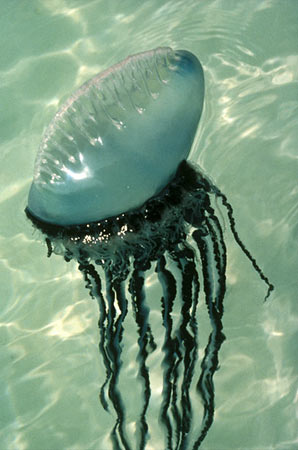
Portuguese man o' war (Physalia physalis),
Myers, P. 2001. "Cnidaria" (On-line), Animal Diversity Web. Accessed February 28, 2011 http://animaldiversity.ummz.umich.edu/site/accounts/information/Cnidaria.html.
