Sunflower (Helianthus Annuus)

Kingdom Plantae is unique for multiple reasons. First, they contain Chlorophylls a and b. The only other organism to contain these two chlorophylls is green algae. Plants are also unique because they have cell wall made of cellulose. Finally, plants have tissues and organs; they have roots, stems, and leaves. Because of these characteristics biologists believe that plants evolved from green algae. As stated above Green Lagae is the only other organism to have chlorophylls a and b. Algae also has cell walls made up of cellulose. Algae also stores glucose as well as has alternation or times when it produces sporophyte (male sex cell) and times when it produces gametophyte (female sex cell).
Plants are multicellular and eukaryotic. This means the plants are formed from multitudes of cells that work togeth to continue life. The cells are complex specialized cells that each have specific funtions. However, because it is a plant these cells have chloroplasts and other membrane bound organelles that are needed to carry photosynthesis.
All organisms in Kingdom Plantae are autotrophic. This means that they all make their own food. This is capable thanks to photosynthesis. Plants use their chlorophylls to create sugars from water, carbon dioxide, and energy form the sun. The digestive system of plants is intracellular.
Plants do not have a nervous system or a complex circulatory system. Plants get what they need by letting it diffuse throughout their bodies from areas of high concentration to low concentration. Plants can be either aerobic or anaerobic, however plants are not nearly as efficient in oxygen free environments.
Plants can reproduce asexually or sexually. When reproducing asexually they either use vegetative reproduction which involves an original piece of the plant or parthenogenesis where a gamete is formed without meiosis and becomes a full clone of its mother. If they reproduce sexually, plants use fertilization to fertilize an egg using spores and eggs create a new and unique offspring.
Examples of Kingdom Plantea can be found above and below the article. For more information on Kingdom Plantae learn about 6 of its phylum: Bryophyta, Pterophyta, Cycadophyta, Ginkgophyta, Coniferophyta, and Anthophyta. Just click on each to follow them to their link.
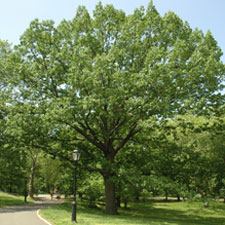
Red Oak (Quercus Rubra)
-
Kingdom plantae. (2010). Retrieved from http://www.svusd.k12.ca.us/schools/lhhs/mccormacks/apbiowebpage/Notes/AP%20Plants%20Notes.pdf
-
Kingdom plantae. (2010). Retrieved from http://www.cartage.org.lb/en/themes/sciences/botanicalsciences/majordivisions/KingdomPlantae/KingdomPlantae.htm
-
Gardener, L.G. (2004, July 7). Kingdom plantae. Retrieved from http://www.windows2universe.org/life/plantae.html
