Amoeba
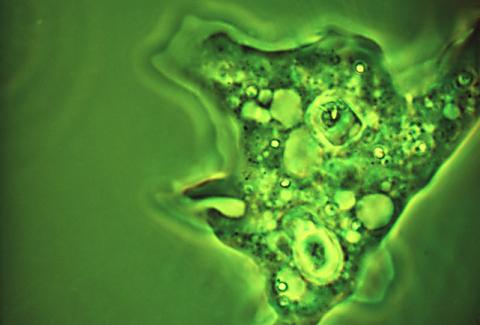
The Kingdom Protista includes a large amount of organisms that consist of algea, protozoans, and slime molds. Every protist needs a water based environment to survive. Whether its fresh or salt water, snow or damp soil, wet animal hair or inside an organism, without a water based environment protists will die. The total number of species is unknown, however, it is estimated that there are between 65000 to 200000. The majority of biologists agree that protists evolved from bacteria and are the forerunners of the kingdoms Plantea, Fungi, and Animalia.
All protists are Eukaryotes. This means that all of them have a nucleus and other membrane bound organelles like mitochondria, chloroplasts, and more. Protists can be unicellular, colonial, or multicellular. This means that protists can be one single cell, can be made up of a group of cells with very similar functions, or can be made up of mulitple cells that each have a specialized function.
Protists can be either autotrophs or heterotrophs. Autotrophs, like algae, have chlorophyll to use photosynthes. With this they can make their own energy. Other protists, like protozoans, need to consume other organisms in order to get energy. All protists, who are heterotrophs, have intracellular digestion. Autotrophs, as stated above, produce their own energy.
Because of a protists small size, they excrete waste and exchange gas through diffusion (passing materials from an area of high concentration to an area of low concentration). The heterotroph protists eat through a method called phagocytosis. This means that The protists will engulf their food in their cell membrane and create a vacuole, or a hollow space inside the cell.
All protists are aerobic and since they are eukaryotic, they have mitochondria that use cellular respiration. The majority of protists do not have a nervous system, as they are unicellular. However some protists who are multicellular will have a rudimentary nervous system. It is not as advanced as the human nervous system, but it does allow them to react to stimuli.
Protists can reproduce asexually or sexually. Protists who are unicellular will reproduce asexually using binary fission. Protists who reproduce sexually can reproduce through meiosis and fertilization. Examples of Protists can be found above and below the article.
For more information about protists learn about some common phyla. These include Ciliphora, Zoomastigina, Euglenophyta, Chlorophyta, Phaeophyta, and Rhodophyta. Just click on the word to be linked to a new page.
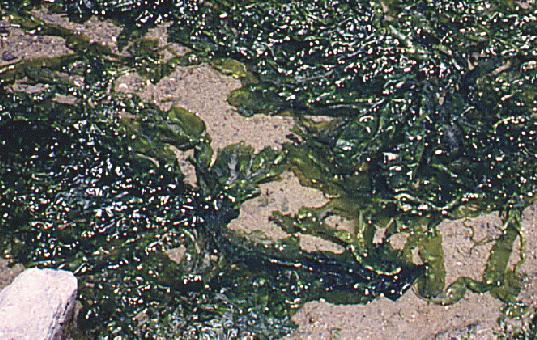
Sea Lettuce (Ulva Lactuca)
-
McNabb, C. (2002, March 27). Phase 3- kingdom protista information. Retrieved from http://pangea.tec.selu.edu/~cmcnabb/etec645/protist2.html
-
Protista. (2004, November 2). Retrieved from http://biology.clc.uc.edu/courses/bio106/protista.htm
-
Kingdom protista. (2010). Retrieved from http://www.esu.edu/~milewski/intro_biol_two/lab_8_protista/Protista.html
