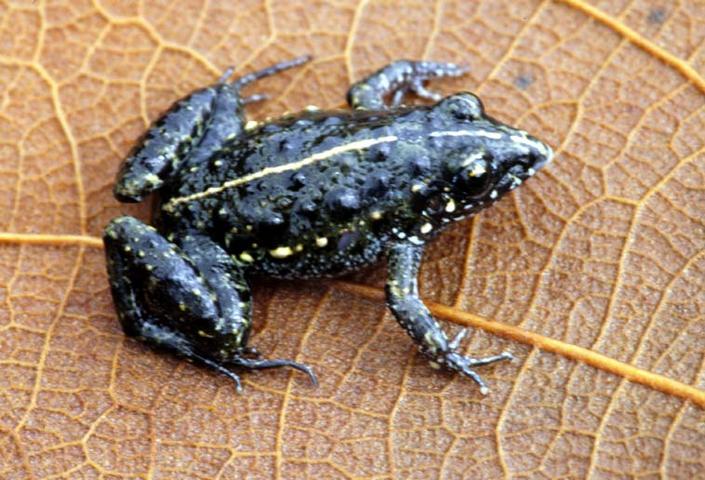
Adenomera martinezi
Kingdom animalia is the largest and most divers kingdom of the six. Biologists are unsure, but estimates say that anywhere from nine to ten million species reside in this kingdom and there could be many more. Animals range in size being anywhere from a few cells to the size of a whale (literally). Organisms from Kingdom Animalia evolved from complex eukaryotic cells.
Organisms in this kingdom are multicellular. They consist of complex eukaryotic cells that are organized together. The cells lack the rigid cell walls that plants have. Because of this they can form together to create tissue. This tissue can then organize together to create organs. These organs work together to create a functioning life for the animals. Animals are also capable of moving rapidly compared to plants and other organisms. This allows the animals even further chance of surviving as they can run from predators.
All animals are heterotrophs. They are aerobic and use oxygen in order to break down their food. They digest their food extracellularly often times in an internal cavity. After the food has broken down, the nutrients are stripped and sent to the cells. The cells then use these nutrients and oxygen and a process called cellular respiration in order to creat ATP. ATP is the energy source for animals without ATP they would be unable to function and die. The circulatory system also disposes of waste as it picks up the waste the cells drop off and takes it to specialized organs whose job is to dispose of it.
An animals circulatory system is what allows these complicated processes to function. In simpler organisms, the sugars produced by cellular respiration diffuse through the body into cells. In more complex systsms the nutrients are carried by the blood stream. The heart pumps the blood to varous parts of the body which the cells then take the nutrients and create sugar to continue to function.
The nervous system of animals controls the movement and behaviour of animals. Impulses pass from the center of control, often times the brain, to the muscles and glands of the animal. It is because of the nervous system that animals can move and perform various behaviors. Whether it is simple reflex or complex intelligent action the nervous system is what allows everything to occur. As animals become more advanced, the nervous system becomes more complex and capable of doing more.
Animals reproduce sexually. Specialized organs called gonads allow the animals to produce genetically diverse sex cells or gamets. Animals accomplish this through through a process called meiosis. With this form of mating, there are multiple steps that most animals go through. When the cells combine and the female egg is fertilized, an embryo is formed. After it starts to divide it becomes a zygote. The zygote continues to develop and go through more steps until the offspring is developed enough to hatch or be birthed.
Examples of the organisms in this kingdom are all the animals on earth: fish, reptiles, birds, etc. Examples can be found above and below the article.
More inforamtion can be found by learning about these 9 common phyla: Porifera, Cnidaria, Platyhelminthes, Nematoda, Annelida, Mollusca, Arthropoda, Echinodermata, and Chordata. To see these links just click on the phyla.
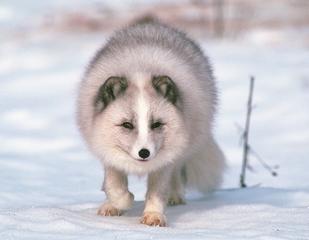
Arctic Fox (Vulpes lagopus)
-
Myers, P. 2001. "Animalia" (On-line), Animal Diversity Web. Accessed February 28, 2011 http://animaldiversity.ummz.umich.edu/site/accounts/information/Animalia.html.
- Animal. (2009). Retrieved from http://encyclopedia.farlex.com/kingdom+Animalia
