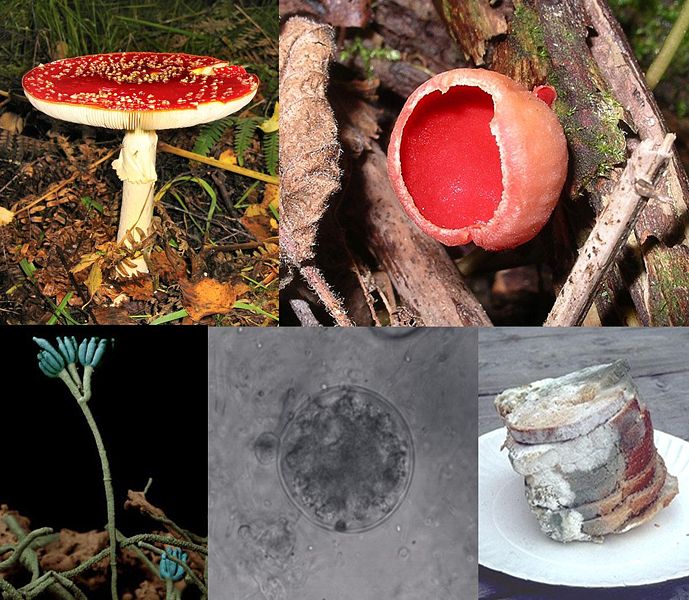
Clockwise from top left: Amanita muscaria, a basidiomycete; Sarcoscypha coccinea, an ascomycete; bread covered in mold; a chytrid; a Penicillium conidiophore.
Organisms in Kingdom Fungi may look like they are related to plants, however, they are actually much closer to animals. Early Fungi were aquatic organisms that branched off from animals. They were eukaryotic cells with flagella until they began to spread spores outwards and evolving to become the Fungi of today.
Fungi is eukaryotic, but may be unicellular or composed of microscopic threads call hyphae. Fungi is a non vascular organism, meaning they dont have vascular tissue. Fungi is also not motile as they cant really move. Fungi, like plants, have an alternation of generations. A fungi's cell wall is similar to plants, but it differs. Fungi wall are made mostly out of chitin while plant wall are made out of cellulose.
Fungi are heterotrophic due to their lack of chlorophyll. However, unlike animals Fungi degest their food before injesting it. Fungi use exoenzymes to in order to do this. They digest the food into small molecules that they can use. Fungi have extracellular digestion
Fungi dont have a heart, but circulatory system is handled by the hyphae. As the mass of hyphae grow into what the fungus is absorbing, they can transport the nutrients throughout the Fungi and to its cells.
Fungi have very small nuclei with little repetitive DNA.. Often times mitosis can be done withouth the dissolution of the nuclear envelope. Fungi reproduce both sexually and asexually. The sexual reproduction involves the union of two compatible nuclei. Fungi often reproduce by using spores. If sexual, the spores fertilize a gamete; if asexual the spores produce a clone of the Fungi.
Examples can be found above the article. There are four phyla:Basidomycota, Ascomycota, Deutromycota, and Zygomycota. To learn more just click on the words to be taken to the link.
- Classifications of organisms. (2006, September 8). Retrieved from http://faculty.southwest.tn.edu/rburkett/classification_of_organisms.htm
-
Volk, T. J. (2000). The kingdom fungi. Unpublished manuscript, Department of Biology, University of Wisconsin, La Crosse, WI. Retrieved from http://www.uwlax.edu/biology/volk/fungi3/sld001.htm
