E-Coli (Escherichia coli)
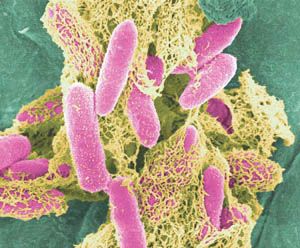
Eubacteria are the most common organisms found in the world. Found on almost all of Earth's surfaces and in organisms both living and dead, they are considered to be "true bacteria". There are nearly 5000 discovered species and it is thought, that as research continues, many more will be discovered.
Eubacteria and Archaebacteria, are thought to have come from a commmon ancestor, however, they have mulitple different features. They are both unicelluar and prokaryotic, but multiple things sepereate the Eubacteria. Eubacteria have a rigid cell wall which holds its organelles inside it. The wall is made up of amino acids and sugars. Also, some Eubacteria have a membrane outside of their cell wall. The cell wall is also lined with a plasma membrane from the inner side. The cell wall is filled with cytoplasm and consists of other cell organelles such as single cell chromosomes and ribosomes. Another characteristic of Eubacteria is that they are often found in six common shapes. They can be Round, Sperical, or Oval shaped. They can be Rod shaped. Or they can be Spiral or Comma shaped.
As stated earlier, Eubacteria are both unicellular and prokaryotic. This means that they consist of a single cell that contains no membrane bound organelles and no nucleus. Eubacteria can be either be autotrophic or heterotrophic. Heterotrophs gain their nutrients by "eating" organic materials and breaking them down. Autotrophs create their own food often times using photosynthesis. Eubacteria digest their food intracellularly and circulate through diffusion (where things go from areas of high concentration to low).
Eubacteria can be either aerobic or anearobic which means some need oxygen to survive and some will die if in an oxygenated environment. Just like Archaebacteria, Eubacteria also reproduce asexually through binary fission. Eubacteria can either be helpful or hurtful to people. Eubacteria is what causes the majority of the diseases in today's world, however, eubacteria is also helpful by maintaining the appropriate nitrogen levels on Earth and decomposing deaed organisms. Examples of Eubacteria can be found above and below the article.
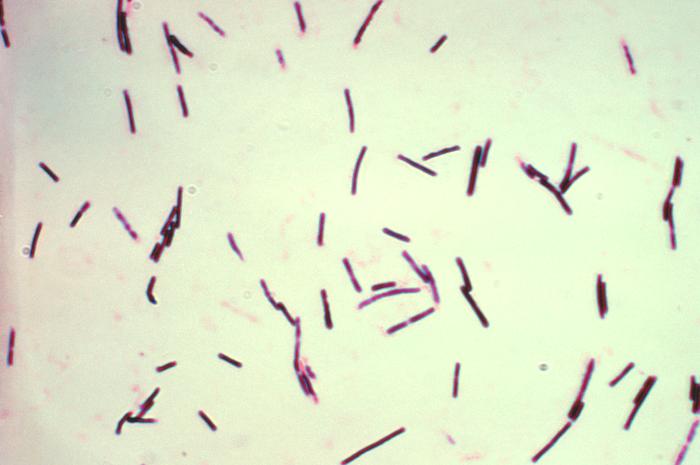
C. welchii (Clostridium perfringens)
-
Niharika, Arya. (2011, Februaruy 11). Eubacteria kingdom. Retrieved from http://www.buzzle.com/articles/eubacteria-kingdom.html
-
Kingdom eubacteria, archaebacteria with cyanobacteria. (2011). Retrieved from http://webhome.broward.edu/~fsearcy/BSC1011C/archaebacteria_eubacteria.pdf
-
Kingdom eubacteria. (2011). Retrieved from http://danmarkltd.tripod.com/taxonomy/id6.html
