Methanobacterium ( Methanobacterium thermoautotrophicum)
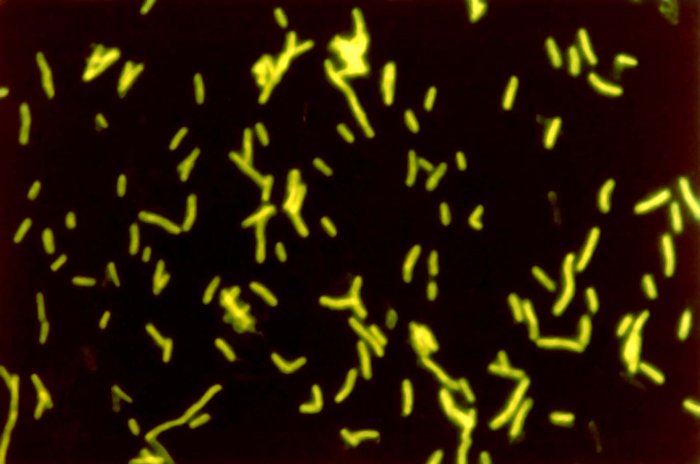
Archaebacteria, discovered in 1977, are the oldest living organisms on Earth as of today. They are believed to come from a common ancestor like bacteria, but are believed to be one of the first life forms to inhabit the earth. They often appear to be normal bacteria when observed, but they are found in very extreme environments where there is high temperature or high pressure. For example, they are found in places like boiling mud around volcanos, volcanic vents in the ocean, and deep sea. All archeabacteria are non pathogenic whcih means that they dont cause illness.
Archaebacteria have several key features that seperate them from other forms of life specifically from Eubacteria. Archaebacteri has no peptidoglycan in their cell walls. This means that cell walls in archaebacteria lack the polymer of sugars and amino acids that form the cell wall in many other forms of bactreria. This cell wall provides the archaebacteria with a more rigid support that allows them to maintain their shape and not burst in a hypotonic environment. Archaebacteria also have a unique lipid bilayer of cell membranesthat are not found in other cells. Finally, the RNA polymerase and ribosomal protein are more similar to a eukaryotes, even though archabacteria are prokaryotic.
Archaebacteria are unicellular and prokaryotic. This means that they consist of a single cell and dont have membrane bound organelles. That includes nuclei, endoplasmic reticulum, mitochondria and more. Archaebacteria can be either autotrophs or heterotrophs as some can produce their own nutrients while others have eat other organisms or molecules for sustenence. Because of the archaebacteria's small size, they have intracellular digestion. This means that they surround what they want to "eat" and pinch of the cell membrane close the substance in. They then digest the substance and use it for energy. Also, because of the archaebacteria's small size, they have no nervousand they circulate through diffusion (where things move from areas of high concentration to low).
Archaebacteria are anaerobic and will die if in the presence of oxygen. This is thought to be due to the Earth having a poisenous atmosphere during the years of archabacteria. The fact that they are anaerobic is what allowed them to survive in the harsh early world of Earth. There are also phyla of archaebacteria. There are Methanogens, Halophiles, and Thermoacidphiles. Methnogens harvest energy by converting H2 and CO2 into methane gas they are what often causes the bubbling in marshes. Halophiles are found in high salt water environments such as the Dead Sea in the middle east. They can survive 10 times the salt concentration of the sea. Finally Thermoacidophiles are archaebacteria who survive in very hot and acidic environments. They can survive in temperatures of around 80 celcius and in environments with a ph of 2.
Archaebacteria reproduce asexually using binary fission. Its bacterial DNA replicates during this process at an extremely fast rate. Some species may replicate themselves every 20 minutes. Examples of Archaebacteria can be found above and below this article.
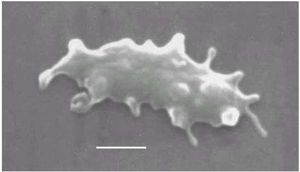
Thermoplasma (Thermoplasma acidophilum)
-
Kingdom eubacteria, archaebacteria with cyanobacteria. (2011). Retrieved from http://webhome.broward.edu/~fsearcy/BSC1011C/archaebacteria_eubacteria.pdf
-
Baxumusa, B.N. (2010, September 3). Archaebacteria kingdom. Retrieved from http://www.buzzle.com/articles/archaebacteria-kingdom.html
-
Baxamusa, B. N. (2010). Archaebacteria examples. Buzzle, Retrieved from http://www.buzzle.com/articles/archaebacteria-examples.html
